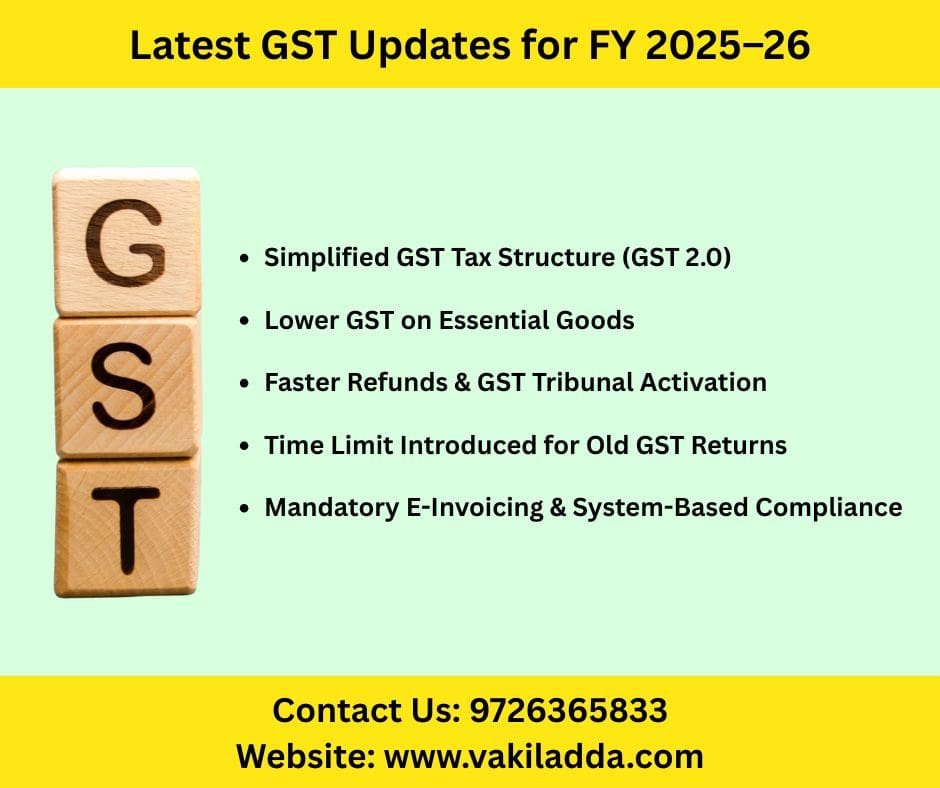
Complete Guide: Latest GST Updates for FY 2025–26
Welcome to our blog, where we explain the Complete Guide on the Latest GST Updates for FY 2025–26 in a simple and user-friendly way. Every year, GST rules are updated to make the tax system smoother, reduce confusion, and improve compliance for businesses and taxpayers. The updates for FY 2025–26 cover important areas such as GST registration, return filing procedures, input tax credit (ITC) eligibility, tax rates, and revised due dates. These changes can directly impact your business compliance, cash flow management, and tax planning. Staying aware of the latest GST updates helps you file returns correctly, avoid penalties and notices, and manage your GST obligations with confidence and ease.
Overview of Latest GST Updates for FY 2025–26
GST compliance and filing in FY 2025–26 have become more system-based and technology-driven to improve accuracy and transparency. The GST portal now auto-fills data, applies system validations, and matches details across different returns. This means businesses must carefully report their sales, purchases, and tax payments. From July 2025, certain fields in GSTR-3B will be locked after auto-population, so any corrections must be made through GSTR-1A before filing. Even small mismatches or delays can result in notices, interest, or restrictions on future GST filings.
Another major update is the introduction of the Invoice Management System (IMS) from October 2025. Under this system, businesses must review and verify invoices before claiming Input Tax Credit (ITC). Only invoices that are accepted will be reflected in GSTR-2B and GSTR-3B, helping prevent incorrect ITC claims. Along with this, e-Way bill and e-invoicing rules have become stricter, with tighter timelines and stronger checks. To stay compliant, businesses should regularly reconcile their GST data, keep records updated, and file returns on time. Following these steps will help avoid penalties and ensure smooth GST compliance in FY 2025–26.
Who Needs Professional GST Support in FY 2025–26?
Professional GST support becomes very important in FY 2025–26 as GST rules are stricter and the system is more automated. Small and medium businesses that do not have a dedicated accounting team often need expert help for return filing, ITC reconciliation, and handling GST portal tasks. New businesses taking GST registration also benefit from professional guidance to ensure correct registration details, proper invoicing, and timely return filing right from the beginning.
Businesses with high sales volume, multiple GST registrations, or regular ITC claims should strongly consider professional GST support to avoid errors and mismatches. Companies receiving GST notices, facing ITC reversals, or struggling with return reconciliation can save time, money, and penalties with expert assistance. Professional support helps ensure accurate compliance, reduces risk, and allows business owners to focus on running and growing their business smoothly during FY 2025–26.
GST Compliance Process for FY 2025–26
Step 1: Registration & Invoice Management
Start with proper GST registration and ensure all business details are correctly updated on the GST portal. Issue GST-compliant invoices for every sale and maintain accurate records of purchases. Correct invoicing is the foundation of smooth GST compliance and helps avoid future mismatches.
Step 2: Data Review & Reconciliation
Regularly review auto-populated data on the GST portal and reconcile your sales and purchase records with GSTR-2B and the Invoice Management System (IMS). This step helps in identifying missing invoices, incorrect ITC claims, or reporting errors at an early stage.
Step 3: Return Filing & Tax Payment
File GST returns such as GSTR-1 and GSTR-3B within due dates and pay the applicable GST liability on time. For businesses under the QRMP scheme, quarterly filing with monthly tax payment should be followed. Timely filing helps avoid late fees, interest, and notices.
Step 4: Ongoing Monitoring & Compliance Support
Continuously monitor the GST portal for notices, mismatches, or compliance alerts and take prompt corrective action. Maintaining proper records and regular compliance checks ensures smooth GST operations throughout the year.
GST 2.0 Updates and Rates for FY 2025–26
In FY 2025–26, GST has been updated under GST 2.0 reforms to simplify compliance, reduce errors, and make tax calculation easier for businesses. The new system focuses on clear tax slabs, stricter return filing rules, and the Invoice Management System (IMS) for claiming Input Tax Credit (ITC). Understanding these changes is essential for accurate billing, correct ITC claims, and smooth business operations.
| GST Rate | Applicable Items / Services | Key Details / Notes |
|---|---|---|
| 0% | Essentials: fresh vegetables, milk, grains, books, basic healthcare & education services | Nil-rated / exempt supplies; no GST liability |
| 5% | Packaged food, domestic LPG, economy air/rail travel, low-value footwear | Standard lower rate for common goods and services |
| 12% | Processed food items, mobile phones, garments within specified limits, some construction-related services | Moderate rate for select products and services |
| 18% | Professional services, IT services, branded goods, restaurants (non-AC takeaway), most consumer products | Most widely applicable GST rate |
| 28% | High-end cars, tobacco products, aerated drinks, luxury hotels, select consumer durables | Luxury & sin goods, higher slab |
| Special / Sector-specific | Real estate, restaurants, transport services, QRMP scheme goods | Follow notified rules for specific sectors |
Additional GST 2.0 Features:
GSTR-3B Hard Lock: From July 2025, some auto-filled fields cannot be edited; corrections must be done via GSTR-1A.
Invoice Management System (IMS): From October 2025, invoices must be verified and accepted in IMS to claim ITC.
E-Way Bill & E-Invoicing Updates: Tighter compliance timelines and stricter rules.
Sector-specific Rules: Certain industries may have special GST rates or compliance requirements.
GST Rate Updates Applicable in FY 2025–26
In FY 2025–26, GST rates continue to follow the standard slabs, and applying the correct rate on goods and services is very important to avoid errors, penalties, or notices. Here’s a simple guide to help businesses understand and use the right GST rates:
0% GST (Exempted Items): Essential items like fresh fruits, vegetables, milk, grains, books, and basic healthcare and education services usually attract nil GST.
5% GST: This rate applies to items like packaged food, domestic LPG, economy class travel (air and rail), footwear below a certain value, and some transport services.
12% GST: Products such as processed food, mobile phones, garments within a certain price limit, and some construction-related services fall under this rate.
18% GST (Most Common): Many goods and services like professional and IT services, consulting, telecom services, branded products, and restaurants (non-AC takeaway) are taxed at 18%.
28% GST (Luxury & Sin Goods): High-end cars, tobacco products, aerated drinks, luxury hotels, and certain consumer durables come under this higher slab.
Special Rates: Some sectors, including real estate, restaurants, transport, and composition scheme dealers, have specific GST rates or conditions to follow.
Tips for Businesses:
Always apply the GST rate based on the correct HSN or SAC code.
Update your billing and accounting software immediately whenever there’s a rate change.
Avoid charging excess GST or underpaying to prevent penalties.
Regularly check official GST notifications to stay updated with any new rate changes.
GST Due Dates and Compliance Timeline for FY 2025–26
Track monthly, quarterly, and annual GST due dates carefully to avoid late fees, interest, or restrictions on future filings.
File GSTR-1 (outward supplies) and GSTR-3B (summary return) on time according to your business type.
Businesses under the QRMP scheme should file quarterly returns but pay tax monthly as required.
Pay your GST liability promptly to avoid interest and penalties.
Maintain a compliance calendar or automated reminders to never miss a due date.
Keep all invoices, purchase records, and supporting documents updated for smooth return filing and reconciliation.
Respond immediately to notices or alerts from the GST portal to avoid blocking or restrictions.
Regularly reconcile GSTR-2B and GSTR-3B to check for missing invoices or ITC mismatches.
Review auto-populated fields in GSTR-3B before submission, especially after July 2025 when some sections are locked.
Stay updated with changes in GST rules, rate updates, and government notifications throughout the year.
Ensure correct HSN/SAC codes are used while filing to avoid errors in classification.
Consider professional support or GST software to simplify tracking, filing, and record maintenance.
Maintain backup of all GST records for at least 6 years as per law for audit or verification purposes.
Input Tax Credit (ITC) Rules and Eligibility FY 2025–26
Input Tax Credit (ITC) is a key benefit under GST that allows businesses to reduce their tax liability on purchases. In FY 2025–26, ITC rules have become stricter, and businesses can claim credit only if the supplier has correctly uploaded the invoice and filed their GST return. Any mismatch between your purchase records and the GST portal may lead to ITC being restricted or reversed. Regular reconciliation and accurate record-keeping are essential to ensure smooth ITC claims.
ITC Rules You Must Follow:
- ITC can only be claimed on goods or services used for business purposes.
- The supplier must have uploaded the invoice and filed their GST returns.
- ITC is not allowed for personal use or exempt supplies.
- Certain credits are blocked, such as motor vehicles (unless used for business), personal expenses, or goods/services for exempted supplies.
- ITC should be claimed based on accurate records in GSTR-3B and matched with GSTR-2B or IMS.
- ITC must be claimed within the prescribed time limit, usually by the September GSTR-3B of the following year or the annual return filing, whichever is earlier.
Eligibility for ITC:
- You must be a registered GST taxpayer.
- The goods or services purchased should be used for business purposes.
- You must have a valid invoice, debit note, or bill of supply.
- The supplier should have paid GST to the government and filed their returns.
Tips to Protect ITC:
- Regularly reconcile invoices with GSTR-2B and IMS.
- Follow up with suppliers if invoices are missing or not uploaded.
- Maintain proper records of all purchases and payments.
By following these simple rules and eligibility criteria, businesses can ensure they claim their rightful ITC without facing restrictions, reversals, or penalties in FY 2025–26.
Documents Required for GST Compliance in FY 2025–26
Proper documentation is very important for smooth GST compliance in FY 2025–26. Keeping only the most important and required documents ready helps in timely return filing, correct ITC claims, and easy handling of GST notices or audits.
Important Documents Required for GST Compliance in FY 2025–26
- GST Registration Certificate
- Updated registration details (business address, bank details, authorized signatory)
- Sales invoices (GST tax invoices) for all outward supplies
- Purchase invoices / bills for inward supplies
- Debit notes and credit notes
- GSTR-1 and GSTR-3B filing acknowledgements
- GSTR-2B statement for ITC reconciliation
- Invoice Management System (IMS) records (accepted or rejected invoices)
- GST payment challans and electronic cash/credit ledger
- Bank statements related to GST transactions
- Expense records and vouchers
- Books of accounts (sales register, purchase register, stock register)
- E-Way bills (where applicable)
- Notices received from GST department and replies
Keeping these key documents updated and organised will help businesses avoid errors, respond quickly to GST queries, and ensure smooth GST compliance throughout FY 2025–26.
GST Penalties and Late Fees for FY 2025–26
Late filing of GST returns results in late fees charged for each day of delay.
Delay in GST tax payment attracts interest on the outstanding amount.
Incorrect reporting of sales or tax liability can lead to penalties and notices.
Wrong or excess Input Tax Credit (ITC) claims may be reversed with interest and penalty.
Mismatch between GSTR-1, GSTR-3B, and GSTR-2B increases the risk of GST notices.
Continuous non-compliance can lead to suspension or cancellation of GST registration.
Serious violations like tax evasion or fake invoicing can attract heavy penalties and legal action.
Timely filing, correct reporting, and regular reconciliation are the best ways to avoid GST penalties.
GST Composition Scheme Updates for FY 2025–26
The GST Composition Scheme in FY 2025–26 is designed to make GST compliance easy for small businesses by reducing paperwork and return filing requirements. It allows eligible taxpayers to pay GST at a fixed, lower rate and file fewer returns compared to regular GST registration. However, businesses opting for this scheme must remain within the prescribed turnover limit and follow all the scheme rules. Composition taxpayers cannot collect GST from customers, issue tax invoices, or claim Input Tax Credit (ITC) on purchases, so this scheme is best suited for small traders and service providers dealing mainly with end consumers.
In FY 2025–26, the GST department is keeping a closer watch on composition taxpayers using system-based checks. If a business crosses the turnover limit, charges GST, issues tax invoices, or claims ITC, the Composition Scheme can be cancelled, and penalties may apply. The business may then be moved to the regular GST scheme, which involves higher compliance and additional costs. To avoid such problems, small businesses should regularly monitor their turnover, issue correct bills, file returns on time, and follow GST portal updates to continue enjoying the benefits of the Composition Scheme smoothly and without stress.
How Businesses Can Prepare for GST Compliance in FY 2025–26 ?
Businesses can prepare for GST compliance in FY 2025–26 by keeping their accounts accurate, updating invoices regularly, and reconciling GST data with the GST portal on a timely basis. Filing GST returns within due dates, paying taxes on time, and checking auto-populated data such as GSTR-2B and GSTR-3B help avoid errors and notices. Using reliable accounting or GST software, staying updated with the latest GST rules, and following rate or compliance changes also reduce risks. When needed, taking professional support can save time and prevent costly mistakes. Being proactive and organised with GST compliance helps businesses run smoothly and stay stress-free throughout FY 2025–26.
Common GST Mistakes Businesses Should Avoid in FY 2025–26
Claiming Input Tax Credit (ITC) without proper reconciliation or when the supplier has not uploaded invoices or filed returns, which often leads to GST notices.
Using the wrong GST rate or incorrect HSN/SAC code, resulting in short payment or excess collection of tax.
Missing GST return due dates, which causes late fees, interest, and sometimes blocks future return filing.
Not reviewing auto-populated data in GSTR-3B before filing, leading to incorrect reporting.
Ignoring mismatches shown in GSTR-2B or the Invoice Management System (IMS), which can affect ITC eligibility.
Poor maintenance of books of accounts and GST records, making it difficult to justify figures during audits.
Keeping outdated GST registration details such as address, business activity, or bank information.
Delayed or no response to GST notices and portal alerts, which can increase penalties and compliance issues.
Not regularly reconciling sales, purchases, and tax payments with GST portal data.
Failing to correct errors in returns on time, even when mistakes are identified early.
Stay Connected for the Latest GST Updates for FY 2025–26
GST rules and compliance requirements keep changing, and staying updated is important to avoid errors, penalties, and missed deadlines. By connecting with us, you can get timely updates on the latest GST notifications, return filing changes, compliance tips, and important due dates for FY 2025–26. We explain GST updates in simple and practical language so businesses can easily understand and take the right action at the right time.
Whether you are a small business owner, professional, or growing enterprise, staying connected helps you remain compliant and stress-free throughout the year. For reliable GST updates and expert support, visit https://vakiladda.com or call/WhatsApp +91 97263 65833. Our team is here to help you manage GST compliance smoothly and confidently.